
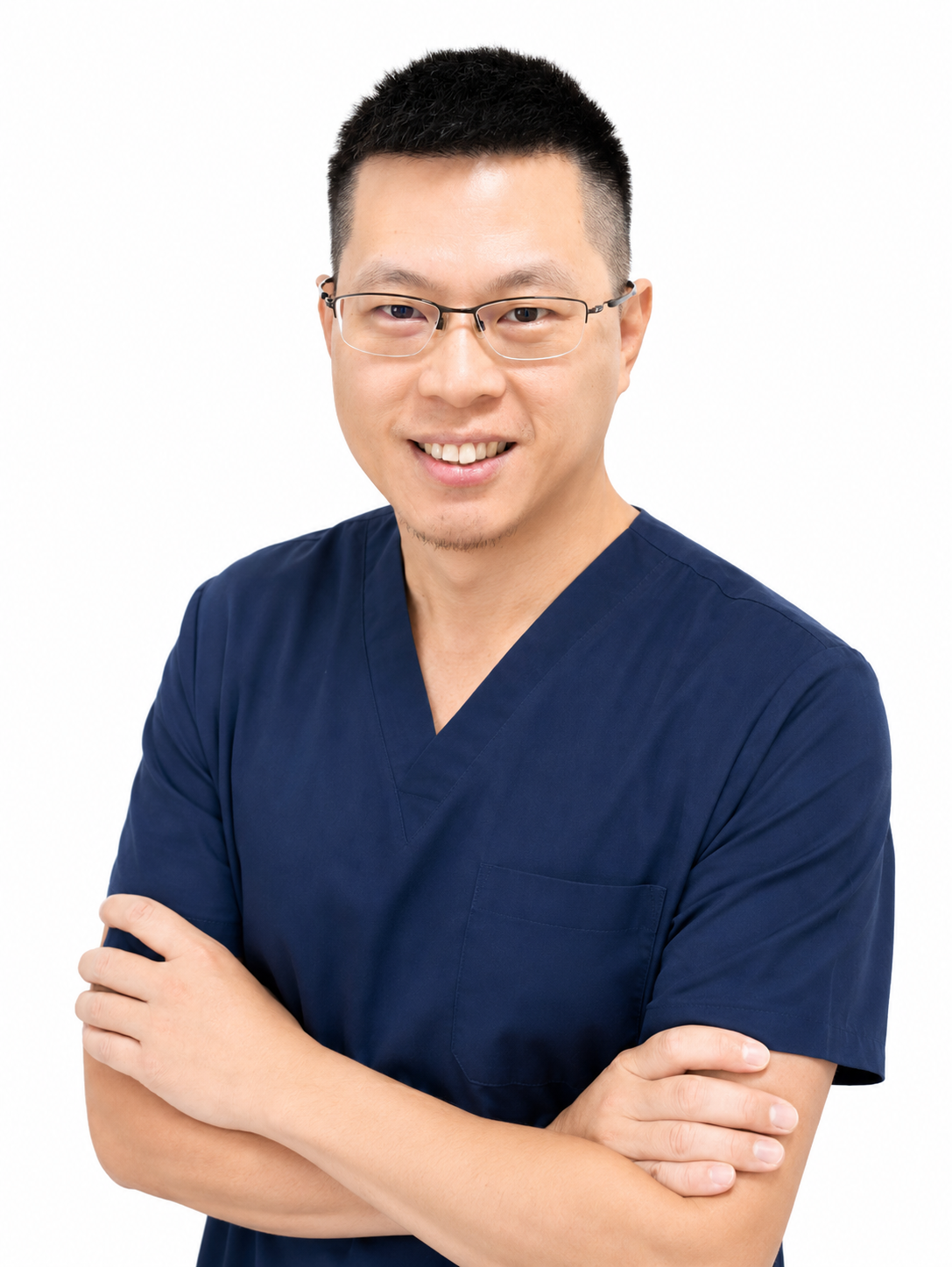
Senior Principal Physiotherapist | Consultant
Dr Kwok Boon Chong
- Diploma in Physiotherapy, Nanyang Polytechnic
- Bachelor of Physiotherapy, The University of Sydney
- Masters of Rehabilitation Science, The University of Melbourne
- Doctor of Philosophy, Nanyang Technological University
- ACSM Clinical Exercise Specialist
- DMA Clinical Pilates Certified
- Founder of Clinical Pilates Family Physiotherapy
- Founder of Bullseye Clinical PilatesTM
BC’s journey into physiotherapy began with a challenge. During his late teenage years, he experienced persistent pain that neither his orthopaedic doctor nor physiotherapist was able to resolve. That experience sparked a question that would continue to shape his career: why were some patients not responding to the treatments available to them?
While studying physiotherapy at Nanyang Polytechnic, BC often felt constrained by the curriculum. He believed that many of the answers he was looking for could only be found through real-world experience.
After graduating from NYP, BC worked full-time while pursuing a part-time degree conversion, which was the final year the programme was offered in Singapore. He began his clinical career at Gleneagles Hospital, drawn to private practice and the opportunity to work in a different environment from the fast-paced nature of public healthcare.
After completing his degree, BC moved to Singapore General Hospital, where he developed a particular interest in chronic disease management. It was during this period, while working with increasingly complex patients, that he became intrigued by directional-bias Clinical Pilates. At the time, it was often described as almost a “miracle treatment”, yet few people truly understood how or why it worked.
BC completed the first half of the course and began seeing meaningful changes in his patients. However, the approach still did not fully answer the challenges presented by some of the more complex cases he encountered, particularly during his time in the polyclinic. He felt that there was still a missing piece to the puzzle.
Rather than accepting that limitation, BC continued his studies and completed the second half of his DMA in directional-bias Clinical Pilates. Two years later, he opened Clinical Pilates Family Physiotherapy, where he continued developing his clinical approach while working with patients across a wide range of conditions.
After completing his Master’s degree, BC was already working with THK Moral Charities and was considering pursuing a PhD. Even with his growing understanding of directional bias, he still felt that there were unanswered questions.
Those questions became the focus of his research. His first PhD study highlighted the need to further modify movement approaches, particularly for individuals who were more sensitive to extreme movements. This led BC to develop and refine his approach to directional classification.
His second study provided further support for his theory. The research demonstrated that his new directional classification could improve the accuracy of exercise prescription and lead to better patient outcomes. The work was subsequently published, providing research evidence for an approach that had begun from years of questioning and clinical observation.
Towards the end of his PhD, BC was invited to collaborate with KJ Therapy. Sharing the belief that neurological and musculoskeletal rehabilitation are closely interconnected, he saw an opportunity to bring Clinical Pilates Family Physiotherapy together with KJ Therapy and lead the physiotherapy approach to patient care.
Today, BC continues to question, investigate, and refine how physiotherapy can be practised. For him, the goal is not simply to follow what is already known, but to remain evidence-informed, using research, clinical experience, and the individual patient in front of him to guide treatment.
Certifications
- Registered Physiotherapist, Allied Health Professions Council (AHPC Singapore)
- Diploma in Physiotherapy, Nanyang Polytechnic 2004-2006
- Bachelor of Physiotherapy, The University of Sydney 2007-2008
- Masters of Rehabilitation Science, The University of Melbourne 2017 - 2018
- Doctor of Philosophy, Nanyang Technological University 2020-2025
- ACSM Clinical Exercise Specialist
- DMA Clinical Pilates Certified
Awards & Publications
- Singhealth Singapore Health Quality Service Award (Silver) 2010.
- NHG Teaching Award for Allied Health Educators 2014.
- NHGP ICare Champion Award (Silver) 2014.
- NTU-NIE Dean’s Commendation for Research 2022, 2025, 2026